Venice Has Two Skateparks Now, and They Got Built in Two Completely Different Ways
On the afternoon of August 15, a small crowd gathered at 1500 Ocean Front Walk for a ribbon cutting. There was a DJ set from Blondie Beach and TYNDAKUT, food from the pro-skater-owned Burger She Wrote, and an open skate session that ran until 4:30. Councilmember Traci Park was there. So was Jesse Martinez, the Venice skating figure whose name shows up in nearly every account of how this neighborhood got its relationship with skateboarding.
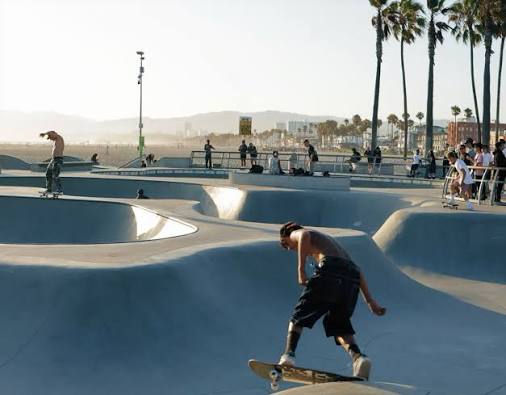
A short walk away, at the skatepark most people actually picture when they hear "Venice skatepark," nothing about the afternoon was unusual. Boards clacked against concrete, tourists lined the fence to watch, and the regular Saturday rotation of local riders worked the bowl like they do most weekends.
Two skateparks, a short walk apart, and most people walking the boardwalk that day probably didn't register that they'd just passed both of them. That's the part worth sitting with if you live here. Venice now has two distinct, purpose-built skate facilities within a few blocks of each other, and the story of how each one came to exist says something real about how this neighborhood gets things done now versus how it used to.
The skatepark most visitors know, officially the Dennis "Polar Bear" Agnew Memorial Skatepark, opened in late 2009 near Windward Avenue and Ocean Front Walk. It runs about 16,000 square feet of bowls, rails, and stairs, and it cost roughly $3.4 million, funded through the sale of surplus city property in Venice, according to the park's own history. That number and that funding mechanism only make sense once you know what preceded them: a documented, two-decade civic fight to get the city to approve a skatepark at all. The documentary "Made in Venice" traces that fight in detail, following Jesse Martinez and a rotating cast of Venice riders, surfers, and neighborhood advocates through years of meetings and stalled proposals, and its own marketing calls the result the most expensive skatepark ever built, largely because of how long the approval process dragged on.
The other skatepark tells a faster story. The site at 1500 Ocean Front Walk, known as the Original Venice Skatepark, a name that nods to its place as the neighborhood's earlier, informal skate spot from before the city built its sanctioned park in 2009, went through the city's recreation and parks commission process in a report dated May 7, 2026. That report flagged the practical realities of building anything on this stretch of coastline: the site sits in a zone the city classifies for coastal, methane, and liquefaction concerns, and any work needed to clear the California Coastal Commission on top of the local sign-off. The report also noted no trees would be removed or added, a small detail that matters more than it sounds like it should in a city where tree removal can stall a project for months on its own.
From that May 7 sign-off to the August 15 ribbon cutting was roughly fourteen weeks. Compare that to two decades, and you're looking at two entirely different models for how a public recreation space gets built in this neighborhood.
The difference isn't that Venice suddenly cares less about process. The coastal, methane, and liquefaction review still had to happen, and the Coastal Commission still had a say. What changed is who's paying and who's organizing.
The 2009 park needed the city itself to find funding, which meant selling municipal property and running the project through the full public works pipeline, a process that invites years of public comment, budget cycles, and political turnover. The 2026 renovation had a private funder from the start: Nicolai Marciano, whose family founded the Guess clothing company, financed the rebuild directly, with project management and design support from The Skatepark Project, the nonprofit Tony Hawk founded in 2002 as the Tony Hawk Foundation. TSP has since helped build close to 700 skateparks across all 50 states, reaching an estimated 17 million people a year, which means the organization walked into this project with a playbook the city didn't have to invent from scratch.
That's the mechanism behind the compressed timeline. It's not that Venice got easier to build in. It's that a private donor and a national nonprofit with two decades of skatepark logistics behind them can move through the same regulatory gauntlet faster than a city department waiting on a property sale and a budget line.
Jesse Martinez is the connective thread between both stories, and that matters more than it might seem. He was the driving force behind the two-decade push that produced the 2009 park. He was also one of the riders consulted on the design of the 1500 Ocean Front Walk renovation, alongside a group that included Juice Martinez, pro skater Ishod Wair, Jim Callans, Dan Levy of Juice Magazine, skatepark designer Alec Beck, and Venice figure Richard Massie.
In other words, the people who actually understand what makes a Venice skatepark work haven't changed. What changed is the funding and organizational structure around them. The same local credibility that took twenty years to translate into a city-built park took about a season to translate into a privately-funded renovation, because this time the money and the process expertise showed up already organized.
Here's a quick side-by-side of what's actually different between the two sites:
Dennis "Polar Bear" Agnew Memorial Skatepark | Original Venice Skatepark | |
|---|---|---|
Location | Near Windward Ave. and Ocean Front Walk | 1500 Ocean Front Walk |
Opened / reopened | Late 2009 | August 15, 2026 |
Funding | City sale of surplus property, roughly $3.4 million | Privately funded by Nicolai Marciano |
Organizing partner | City of Los Angeles public works process | The Skatepark Project |
Approval timeline | About 20 years of advocacy | About 14 weeks from city sign-off to reopening |
Design consultation | Jesse Martinez, Pat Ngoho, Christian Hosoi, and other Venice riders | Jesse Martinez, Juice Martinez, Ishod Wair, Jim Callans, Dan Levy, Alec Beck, Richard Massie |
For anyone who spends weekends on the boardwalk, the practical upshot is that this stretch of Ocean Front Walk now has two working skate destinations instead of one, plus the rest of the Venice Beach Recreation Center's usual lineup: the basketball courts, the Muscle Beach outdoor gym, the boxing area, and the sand-pit gymnastics setup that's been part of the boardwalk for decades. If your Saturday routine already runs toward the 2009 park to watch the regular crowd work the bowl, it's worth extending the walk to 1500 Ocean Front Walk to see what the renovated original site looks like now that it's back in regular use.
None of this changes the boardwalk's basic character. It's still loud, still crowded on weekends, still the kind of place where a fishing pier, a skate plaza, and a decades-old bodybuilding gym coexist within a few hundred yards of each other. What's different is that a piece of Venice's skate history that had quietly aged out of daily use is back on the rotation, rebuilt by people who understood exactly what needed protecting about it.
That's the pattern worth noticing if you live in this neighborhood long enough. Venice doesn't lose its landmarks so much as it waits for the right combination of money, expertise, and community memory to show up and rebuild them. Sometimes that takes twenty years and a documentary crew. Sometimes it takes a family with the resources to write a check and a nonprofit that already knows how.
If you've spent enough seasons in Venice to recognize what changed at 1500 Ocean Front Walk without needing it explained, you already understand what makes this neighborhood function day to day. That kind of local read, the kind that comes from actually walking these blocks for years, is the same instinct that matters when it's time to make a move here, whether that's buying your first place a few streets off the boardwalk or figuring out what your longtime home is worth in the current market. Terry Ballentine has been working this stretch of the Westside long enough to have watched more than one Venice landmark get rebuilt, and he's always glad to talk through what's changing in the neighborhood, real estate question or not.

With more than 50 years in Westside real estate, Terry Ballentine offers unmatched expertise in Marina del Rey, Venice, and nearby coastal communities. He provides personalized guidance for buyers, sellers, and investors, earning long-term trust and repeat clients. Terry’s hands-on approach and deep local knowledge ensure every transaction is handled with care and precision.
Terry Ballentine | CA DRE# 00588883
124 Washington Blvd Marina Del Rey, CA 90292